| Model | Cylinder diameter(mm) | Cylinder length(mm) | Cylinder volume(m3) | Cylinder rotary speed (r/min) | Power(kW) | Weight(t) |
| VS 0.6x5.8 | 600 | 5800 | 1.7 | 1-8 | 3 | 2.9 |
| VS 0.8x8 | 800 | 8000 | 4 | 1-8 | 4 | 3.5 |
| VS 1x10 | 1000 | 10000 | 7.9 | 1-8 | 5.5 | 6.8 |
| VS 1.2x5.8 | 1200 | 5800 | 6.8 | 1-6 | 5.5 | 6.7 |
| VS 1.2x8 | 1200 | 8000 | 9 | 1-6 | 5.5 | 8.5 |
| VS 1.2x10 | 1200 | 10000 | 11 | 1-6 | 7.5 | 10.7 |
| VS 1.2x11.8 | 1200 | 11800 | 13 | 1-6 | 7.5 | 12.3 |
| VS 1.5x8 | 1500 | 8000 | 14 | 1-5 | 11 | 14.8 |
| VS 1.5x10 | 1500 | 10000 | 17.7 | 1-5 | 11 | 16 |
| VS 1.5x11.8 | 1500 | 11800 | 21 | 1-5 | 15 | 17.5 |
| VS 1.5x15 | 1500 | 15000 | 26.5 | 1-5 | 15 | 19.2 |
| VS 1.8x10 | 1800 | 10000 | 25.5 | 1-5 | 15 | 18.1 |
| VS 1.8x11.8 | 1800 | 11800 | 30 | 1-5 | 18.5 | 20.7 |
| VS 1.8x15 | 1800 | 15000 | 38 | 1-5 | 18.5 | 26.3 |
| VS 1.8x18 | 1800 | 18000 | 45.8 | 1-5 | 22 | 31.2 |
| VS 2x11.8 | 2000 | 11800 | 37 | 1-4 | 18.5 | 28.2 |
| VS 2x15 | 2000 | 15000 | 47 | 1-4 | 22 | 33.2 |
| VS 2x18 | 2000 | 18000 | 56.5 | 1-4 | 22 | 39.7 |
| VS 2x20 | 2000 | 20000 | 62.8 | 1-4 | 22 | 44.9 |
| VS 2.2x11.8 | 2200 | 11800 | 44.8 | 1-4 | 22 | 30.5 |
| VS 2.2x15 | 2200 | 15000 | 53 | 1-4 | 30 | 36.2 |
| VS 2.2x18 | 2200 | 18000 | 68 | 1-4 | 30 | 43.3 |
| VS 2.2x20 | 2200 | 20000 | 76 | 1-4 | 30 | 48.8 |
| VS 2.4x15 | 2400 | 15000 | 68 | 1-4 | 30 | 43.7 |
| VS 2.4x18 | 2400 | 18000 | 81 | 1-4 | 37 | 53 |
| VS 2.4x20 | 2400 | 20000 | 91 | 1-4 | 37 | 60.5 |
| VS 2.4x23.6 | 2400 | 23600 | 109 | 1-4 | 45 | 69.8 |
| VS 2.8x18 | 2800 | 18000 | 111 | 1-3 | 45 | 62 |
| VS 2.8x20 | 2800 | 20000 | 123 | 1-3 | 55 | 65 |
| VS 2.8x23.6 | 2800 | 23600 | 148 | 1-3 | 55 | 70 |
| VS 2.8x28 | 2800 | 28000 | 172 | 1-3 | 75 | 75 |
| VS 3x20 | 3000 | 20000 | 141 | 1-3 | 55 | 75 |
| VS 3x23.6 | 3000 | 23600 | 170 | 1-3 | 75 | 85 |
| VS 3x28 | 3000 | 28000 | 198 | 1-3 | 90 | 91 |
| VS 3.2x23.6 | 3200 | 23600 | 193 | 1-3 | 90 | 112 |
| VS 3.2x32 | 3200 | 32000 | 257 | 1-3 | 110 | 129 |
| VS 3.6x36 | 3600 | 36000 | 366 | 1-3 | 132 | 164 |
| VS 3.8x36 | 3800 | 36000 | 408 | 1-3 | 160 | 187 |
| VS 4x36 | 4000 | 36000 | 452 | 1-3 | 160 | 195 |
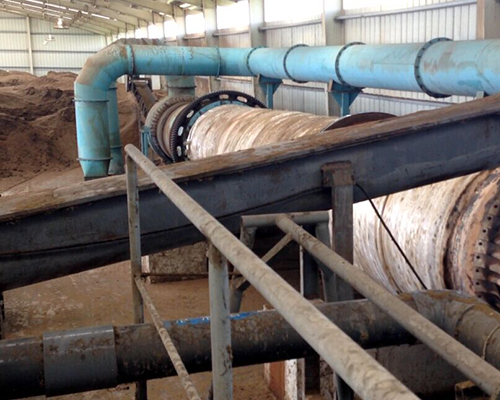
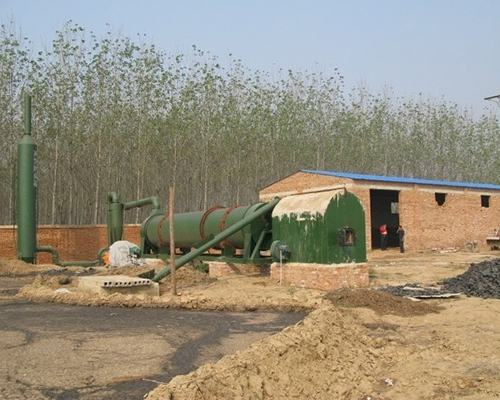 The dewatered material will be transported to feeding head of the dryer through the screw conveyor after scattering, and then it will be sent into the inside of the dryer through the unpowered spiral sealing feeder (the patent technology of our company), and going through several following working areas after getting into the dryer: 1. Material leading-in area The material will come into contact with the high temperature negative pressure air after getting into this area and plenty of water will be rapidly evaporated, and the material can’t be formed into sticky stuff under the stirring of large guide angle lifting plate. 2. Cleaning area The material curtain will be formed while the sludge is lifted up at this area, and it will cause the material stick on the cylinder wall while it’s falling down, and the cleaning device is installed at this area (Lifting style stirring plate, X type second time stirring plate, impacting chain, impacting plate), the material can be quickly removed from the cylinder wall by the cleaning device, and the cleaning device can also crush the materials which are bonded together, so as to increase the heat exchange area, increase the time of heat exchange, avoid the generation of wind tunnel phenomenon, improve the drying rate; 3. Inclined lifting plate area This area is the low temperature drying area, the slime of this area is at the low moisture and loose state, and there is no adhesion phenomenon at this area, the finished products reach the moisture requirements after the heat exchange, and then enter the final discharge area; 4. Discharging area There aren’t stirring plates at this area of the dryer cylinder, and the material will be rolling to the discharging port. The material gradually becomes loose after drying, and discharged from the discharging end, and then sent to the designated position by the conveying device, and the fine dust drawn out along with the tail gas is collected by the dust collector. Hot air enters into the drying machine from the feeding end, and the temperature is gradually reduced at the same time of material convection heat transfer, and the water steam taken out under the suction of induced draft fan, and then emitted into the air after processing.